Showing posts with label Interview. Show all posts

Monday, February 14, 2011

Interview : Kings Go Forth

Initially Published Here


Milwaukee’s Kings Go Forth are a 10-piece funk and soul revue with a live show to rival the most intense rock band you’ve ever seen. Led by singer/writer Black Wolf, the vocals may be sweet but there is considerable muscle behind bass player/band leader Andy Noble’s arrangements. The band’s debut full-length, The Outsiders are Back (Luaka Bop Records), came out in the spring of 2010 and the band is making their first stop in Philly at Johnny Brenda’s on February 18th. I had the opportunity to talk with Andy about the ins and outs of taking such a mighty (and mighty big) band out on the road.

Andy, I had the chance to see you guys play a record store in Austin at the last South by Southwest conference and I was completely blown away and...

Oh, we’ve gotten ten million times better since then! I feel like right now is the first time I can really recommend us -- like, “You need to see this show.” And it’s because of Europe. We actually went on a real tour where it was just eat, drink, sleep, play a show, all the time. We’d never done that before. We did two weeks of shows and the feeling instantly was yeah, that’s how you do it.

When you talk about the logistics of touring with a 10-piece band...you don’t go to Europe and pick up a horn section or pick up a percussionist do you?

No. The logistics of bringing my guys everywhere are hard, but the logistics of doing that are even harder. Not to mention that I’m really particular. We’re trying all the time to get better and better and that wouldn’t happen if we were changing out members. That’s too much like a ‘show band’. If you were in The Clash you wouldn’t have a guy who plays bass in the US and another guy in Australia! No one would accept that and that’s how I think about our group. I don’t think about us as being like Sharon Jones, I think about us as being like The Who.

In a perfect world would you like to see Kings Go Forth on the road all the time?

I don’t think so, but things change. A year ago I would have said no, I just want to work in the basement on drum sounds. But after touring Europe I just wanted to go right back. I am addicted to the point that when I eat now I kinda mimic hospitality rider food. You know, you get hummus but no pita bread, so you scoop it up with a baby carrot (laughs). Just a vain attempt to keep on tour in my head while it’s a Tuesday afternoon in Milwaukee.

But motivations change and life changes. And this band sorta ruined a serious relationship... but, without going into too many details --, a year ago that was the most important thing in my life and I wasn’t looking to go on the road and now I just wanna go on the road all the time. But the thing that greases the wheels is money. I mean, we all need it and we’re not even close to “getting rich” money, I’m just talking about sustenance. If I take these guys on the road, I’ve got to be able to at least cover what they would have been making at home.

And you’re not crashing on people’s floors with 10 people.

Yes, but there’s a more practical explanation for trying to maintain some sort of lifestyle on the road. The show is so physical that I need to baby the group. I’ve got to make sure that the singers can sing the next night. And the drummer and conga player are basically running a marathon at every show and they’ve gotta be able to do it the next night. I can’t tell those guys to go crash on someone’s floor. Or hey, there’s no more floor space available but there’s a chair over there!

I’m curious how you feel about Kings Go Forth being included in what’s called the ‘Soul Revival’, whether it’s Sharon Jones or the Budos Band or...

Well, obviously a lot of that is business and marketing. People have to figure out how to sell your band.

But is this something you try to distance your band from or something you embrace?

I fall somewhere in between. Obviously I want people to hear about our band but also recognize that we come from a different place. It’s a double edge sword. If I was working for the marketing firm I’d probably be doing it even more, but in America there is no precedent of ‘Northern Soul’ -- these club scenes based on black American music like you have in Europe or Japan that have existed for decades.

In America our label cares so much about something like Pitchfork, which would seem on the surface to have very little in common with what we do, but the only people who buy CD’s in mass anymore are people who buy indie-rock. So our label has to think about that -- “Okay, is this the soul group that we can get indie-rockers to buy?” My business is just to make records that I like. I know there are other people who have different jobs to do. But the way they sell our band in America vs. the rest of the world is very different. But hey, when I see on someone’s Facebook page that they like Kings Go Forth and the next band is...I dunno, Radiohead, hey that’s cool (laughs). People need more variety. I like when people take their musical inspiration wherever they can get it.

Kings Go Forth bring their amazing live show to Philly for the first time at Johnny Brenda's (1201 Frankford Ave.) on Friday, February 18th. Show starts at 9pm and tickets are $12.

Monday, December 6, 2010

Interview : Tanya Hamilton

Initially Published Here


Night Catches Us is a remarkably assured first feature for director and writer Tanya Hamilton. The story of men and women coming to grips with the aftermath of the Black Panther Party’s disintegration in ‘70s Philadelphia, the film is refreshingly contemplative and never feels less than true to its characters or setting. We recently had the chance to spend some time with Ms. Hamilton, who described her decision-making process and how she channeled her background as a painter into her first film.


I was impressed with how you managed to make a film set in the ‘70s while avoiding all of the clichés associated with the period (costume design, hair, soundtrack, etc.). What were some of the challenges? 
I think money, really, to be crass. There are things I wanted to do that I couldn’t because I just didn’t have enough. Like shooting at night, or having a bunch of cops on the street. We had to be creative about these things, which I think worked. I have a great dislike for the garishness of the ‘70s. I love the aesthetic in a way but I think it’s so over-the-top. I knew that I didn’t want to have anything to do with that. I think I treasure subtlety pretty much in every way, sometimes too much.

I was curious how the film came to be set in Philadelphia. Is this a story you could have adapted to Black Panther history in another U.S. city?
Sure, there’s no doubt I could have adapted it in many ways to anywhere. I think I try to write what I know … cuz I’m not good at writing what I don’t know. Some people are good at making it up. I’m not one of those people. So I knew Philly by the time I wrote it in ’99. It was always set here just because it felt like the South. I was so heavily influenced by To Kill a Mockingbird, and by that idea of the neighborhood. I was so influenced by the South that New York made no sense and Philly was the only other place I knew besides D.C.

You've talked about bringing concepts like deconstruction and reconstruction to your filmmaking. A couple of scenes that really stuck with me were the sequences composed in extreme long shot. Did you shoot lots of coverage and then in the editing room decide, “All the scene needs is this.” Or did you know on location?
Again, that’s where I got into some trouble. Marcus under the bridge for instance, the scene was written to kind of show his isolation. I knew that I needed a visual transition to take me from that scene into the house and I knew that I ultimately needed to speak in subtext to what I wanted, which was that [isolation]. And similarly with Jimmy, I knew that the further I got away from his family, the more the landscape had to change and become more apocalyptic and also the shots had to be wider. So yeah, you want to see that building. Not only was it falling down and decaying, but when you look through those windows it looks like the seaside. It doesn’t look like there’s anything beyond it. That metaphor was important to me. He progressively moves so far away from his family and therefore so far away from reason and sanity and everything keeping him grounded, and that building spoke to us.

Knowing your background as a painter, I thought about the scene towards the end of the film where the police are going through the woods looking for the suspect. I started to think about that in terms of light and perspective, the fireflies--
Yeah, that was an accident -- the fireflies.

That’s a Philly thing in the summertime.
It’s really great. What can I say? It was a stressful day. I was like, “The light is fading! The light is fading!” I think that there’s a visual collaboration between myself, the D.P. and the editor and I think we all spoke the same language, were all interested in how do you tell the story visually, how do you tell it slowly? And not slow just to be slow but a respect for the period this comes from which is the ‘70s. I think people took their time a little more. We also wanted to find ways to give breaths throughout the film and to tell it as much in metaphor as we could. Part of that is frankly because of money. It’s the language I spoke no matter how much I tried to run away from it. We wanted to have that shot of the policeman’s feet. In part, we just couldn’t afford more policemen so the question was how do we recycle these guys without sort of tipping our hand? But also there was a real desire to abstract them. It’s not about police who kill people, it’s about this guy and so we thought a lot about it.

I thought about the fact that the film is 88 minutes but you still take your time with things. Did you cut out large chunks of exposition and narrative?
There was a ton of exposition. Really, as a writer, I don’t focus a lot on the ‘math’ stuff. It’s really something I struggle with. I’m just more interested in people and how they relate to one another and how they’re dealing with their stuff and so consequently, I think I’m not necessarily the best person at setup. So those first 20 minutes we struggled until the last breath before we had to let it go for Sundance and it was hard. There were fundamental things that I look back on that I purposefully said, “I don’t want that,” but you need them because you have to tell the story in this very specific way for people to find their way in. I still think there are some things we couldn’t do because we didn’t have the footage but I think we made the absolute best that we could.

And you can make yourself crazy trying to chase down what everyone wants.
It’s true. I let go which was nice. That panic that sets in of “I’m not telling the story in a way that people can understand” – and then sort of looking through all your footage and realizing you have to throw a ton of stuff out because creatively it doesn’t make sense. And then, in throwing it out, it brings up new problems. I needed to place Jimmy in the world of this family and I hadn’t shot it and I was like,”How did I miss this important thread?” And Jimmy is my favorite character and his arc was the one that I just spent so much time thinking about, but I think you can get into your head and sort of leave a little of the math behind.

I’m wondering how much time and effort you are going to spend for the 10 percent of the audience that might question how the policemen find Jimmy.
Yeah, none. As an audience member, I’m happy to be led. I’m happy to make the leaps I need to make. That’s quite different than how I establish my characters in the world that they’re going to live in versus a piece of math – “I need A, B and C.” – I’m cool with just going from A to C because my mind can say “They found him. It doesn’t matter how.”

At the beginning, when I mentioned some of the tropes of ‘70s movies, I said that your soundtrack didn’t fall into those usual traps. How did The Roots come to be involved? At what point in the process?
There were on pretty early. I knew their agent and she thought they’d be really great and I was like “Yeah” because I love them and they’re amazing and they are Philly and they’re very blackety-black which I love and it just sort of made sense. We looked to the Roots to be our bridge between the past and this present.

What have the past 11 months been like for you?
It’s been a great experience, actually. I’m not a fan of the growing exponential world that film is: I’d rather spend time with my child and my husband. But the part I really love is showing the film to audiences and then having this conversation with them. The biggest surprise is how many people can connect to the film. It’s so unlike what I thought. I’m very interested in the working class and the working poor and how do you ultimately speak to those audiences. How do you tell people’s stories with dignity? Frankly, I don’t think I ever thought (about) if I had achieved it and now I go around and all different kinds of people connect to it and that I find extremely lovely.

The film struck me as incredibly truthful regardless of whether or not I was ever in those circumstances or people that I know were. 
Yeah, that’s really flattering. I think that there are these elements, these themes, that connect to all these different people which I think is great. That’s why I think it’s a film that can reach a lot of different audiences.

Thursday, November 4, 2010

Interview : Danny Boyle

Initially Published Here


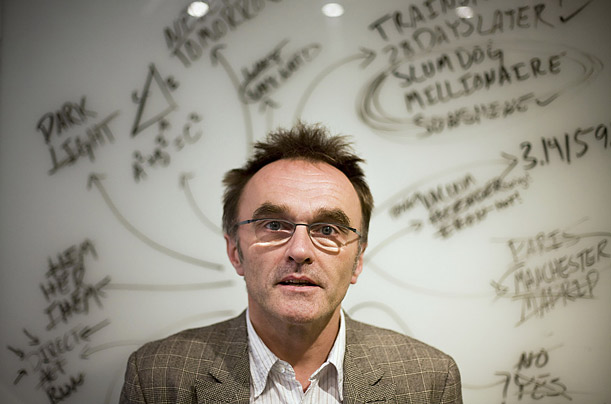
Director Danny Boyle (Trainspotting, Slumdog Millionaire) loves extremes. His films are filled with people doing extraordinary things under extraordinary circumstances. And his is a case of style following content -- breathless movement, jarring close-ups, split screens, rapid cutting. Affectations in the hands of a lesser artist, for Boyle, the go-for-broke imagery is perfectly in keeping with the stories he’s telling. On the surface, that wouldn’t seem to be the case with his new film, 127 Hours, essentially, the true life single protagonist survival story of Aron Ralston, the hiker who amputated his own arm after being pinned by a boulder in a secluded canyon in the Utah desert. But Boyle manages to jam as much action into the piece as your typical Hollywood blockbuster, aided by a bravura performance by James Franco who’s on screen by himself for most of the film’s taut 90 minutes. We had the opportunity to speak with Mr. Boyle briefly while he was in town promoting the film’s appearance at the Philadelphia Film Festival. Here, he discusses his efforts to remain truthful to Aron’s story and the difficulties of getting the film made, even for an Academy Award winning director.

At what point in the process did you have a vision of how you were going to depict the big moment?

Well, it’s in the book. The writing of that sequence where he describes doing it, I remember thinking that whatever I do, I’m gonna be honest to that and if they cut it, I’ll walk away from the film because you have to do that honestly. It took him 44 minutes. I don’t think Aron was a natural writer before this happened but there certainly are other people. He’s one. Joe Simpson [author of Touching the Void] is another. Primo Levy is another. Where writers are made by experience and the gift is bestowed upon them by the extreme experience they go through.

Was there any concern on your part or on the producers’ part about turning off potential viewers?
Yes. The studio was terrified of that, still, even though its getting good buzz, they’re still obviously scared.

But ultimately, what’s there is what you wanted?
Sure. It’s very honest and truthful. And then, to be fair to them, they haven’t suggested changing it. They realize that what we presented to them with the first cut, that sequence was accurate and it wasn’t exploitative. It was troubling, but faithful to the experience because, of course, you can’t change the ending.

Certain filmmakers in the position of critical and financial success such as what you had with your last movie, use that opportunity to make a difficult project or something extremely personal that they otherwise wouldn’t be able to do. Is this film something that couldn’t have been done without the success that you had?
It would never have been made.

Really?
I mean, Spielberg could have made it, but most filmmakers would never be allowed to in the current climate. They’re so nervous about the market, you know, just what people want to go and see and stuff like that. So yes, we did take advantage of the success we had with Slumdog.

Is this something you had in mind while doing promotion for Slumdog?

Well, funny enough, I approached Aron about it, [but] he wanted to make it as more of a documentary then and it was his story, you know, so you back away and then when it came back again, it was sort of after the promotional tour, sort of obvious that we could take advantage of the hullabaloo and the financial climate that Slumdoghad had. You know, we have a few credits in the bank with the studio so we used the same studio. We morally embarrassed them into agreeing to let us make the film. No, I’m kidding.

I understand the actual video that Aron makes where he’s saying goodbye is something only certain family and friends had seen but you and James Franco had been granted access. Was Aron involved in that discussion of how to use it for the film? Is it closer to the spirit of what was on the tapes?

Aron was involved in a lot of this. A lot of it’s in the book, so he did reveal that. What he doesn’t like is showing the tape but he did show it to us eventually. And we made departures. One was the girls in the beginning with the swimming and the second one was actually his talk show host – James’ talk show host, you know, when he does the multiple characters. That isn’t on the tape but the bit that follows is when he gives up trying to entertain everyone and says, “Mom, Dad, I don’t appreciate you half as much as I know I could” – that’s all verbatim. The reason for the talk show host thing and what was extraordinary about the tapes, was that he is very composed, very controlled. And of course, you realize that what he was trying to do was leave a dignified impression of himself for his parents to see after he died because he did think he was going to die and he thought “I don’t want them to see me going ‘Please help me somebody.’” He wanted to look noble and dignified like he was trying his best and he loved them all. He said if he did crack and feel sorry for himself, he went back over the message [and] erased [it] in the place and rerecorded a dignified message. That gave us the idea of him performing in order to cheer himself up, to kind of persuade himself and others who might watch them that he’s coping with this, you know, and so that led to the talk show host. Those are the two major changes we made to the story. The rest of it is verbatim.